The Ukrainian War Requiem: Grief, Hope, and Solidarity Through Music
The Axios Men’s Ensemble is touring their Juno Award-winning piece, Ukrainian War Requiem, across Canada.
Like great art does, this piece has a way of capturing a collective feeling while leaving space for our own experiences. This is even relfected in the choir. We have the choir as a whole singing together, but when you zoom in to each person and listen to their individual voice, you’re reminded they have their own grief they’re experiencing, and now sharing. And all together, those individual experiences give the music another layer of meaning.
We chatted with Steven Brese of Axios Men’s Ensemble about how the Ukrainian War Requiem came to be, the stories behind the music, and what it means to share the work with audiences across the country.
Read on for a transcript of our interview, or listen to the full episode at this link (plus, get a preview of what you’ll hear at the show).
And be sure to check out Axios when they perform in a city near you! Click here to buy tickets.
Edmonton: November 6, 2026
Saskatoon: November 7, 2026
Winnipeg: November 8, 2026
Montreal: November 10, 2026
Ottawa: November 11, 2026
Hamilton: November 12, 2026
London: November 13, 2026
Kitchener: November 14, 2026
Toronto: November 15, 2026
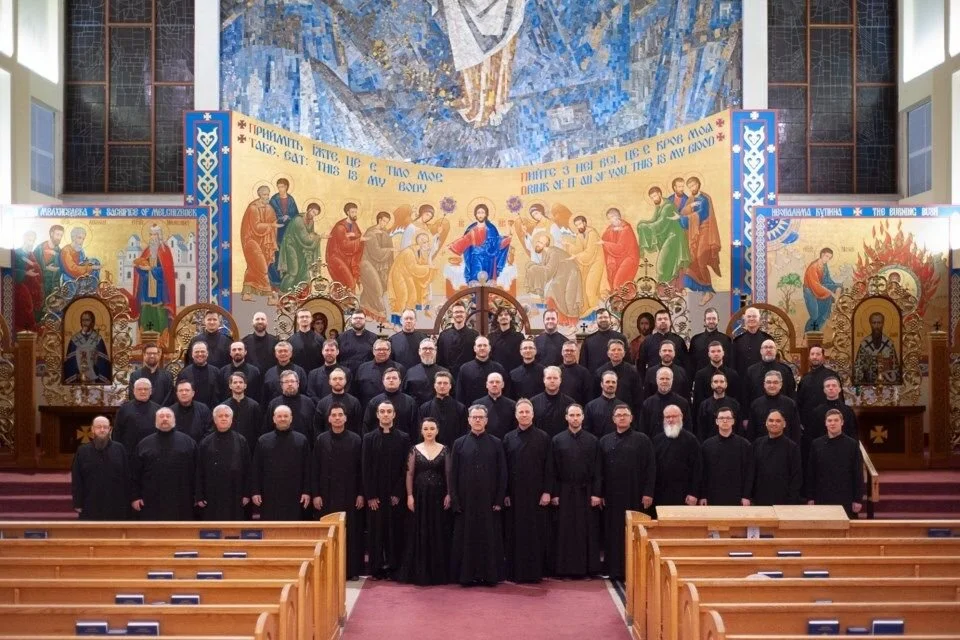
Q&A with STEVEN BRESE
Take us to the start of how the Ukrainian War Requiem came to be.
Just after russia’s full-scale invasion of Ukraine started, there was a group of us who said we should get together and talk about what was going on. We’re a bunch of guys who sing together in a choir called Axios Men’s Ensemble.
In early March 2022, we called each other up and said this is really impacting us and friends that we have in Ukraine, and we’ve got to get together and talk about it.
So, a group of us got together at Julian’s Piano Bar in Edmonton, the city we’re all from and where we sing. Over the course of the evening, we chatted about how this war had come so close to our lives. Over the years, we’d sung with Ukrainian fellows who live in Kyiv and Lviv, and we were saying to each other, “What can we do?”
We’re guys who live in Edmonton. We’re not fighters. We have no ability to really affect or make any kind of impact on what’s going on, this terrible injustice. We said to each other, “Well, look, we sing music. We sing Ukrainian liturgical music. That’s what we do. Could we not do something in that vein to support Ukraine?”
Toward the end of the evening, we said, “Well, what if we…?” This was big, blue-sky thinking over a couple of beers. We said, “What if we were to talk to a composer and see if he would compose brand-new music that we could sing, that would honour Ukraine’s fight for freedom and its sacrifice in this unjust war?”
Before russia’s full-scale invasion had started, we’d been throwing ideas around about what our next project could be. We already had a shortlist of composers we’d love to work with, and right at the top of the list was this fellow, Benedict Sheehan.
He’d already been nominated twice for a Grammy, and he was our absolute number one, first choice. We’d never talked to him before, but we thought, “I wonder what would happen if we, Axios in Edmonton, wrote him an email and told him what we wanted to do?”
Maybe we’d never get a response from him. Maybe he’d say, “This isn’t interesting.” But we thought, “Let’s just take the shot. Let’s write him an email.”
The next day, we wrote him an email saying exactly what we wanted to do. And you know what? He wrote back immediately. He said that since the war had started, he’d been looking for a way to voice his displeasure and disgust with russia’s invasion, and to show solidarity with Ukrainians.
How did conductor Michael Zaugg get involved?
For the past 10 years, we’ve worked with Michael. He’s the creative director and conductor of Pro Coro Canada.
Axios is a choir that doesn’t meet regularly. We don’t have weekly rehearsals on Wednesday nights. We get together whenever there’s a project, whenever we come up with an idea that we want to bring into reality.
Ten years ago, we wanted to record an album for the first time. We looked around in Edmonton and thought, “Who would be the best person to help a group of guys — amateurs — bring out the very best in our creative and vocal talents?”
We figured, “Let’s take a chance on Michael,” and it was probably the best decision we’ve ever made. He has such an ability to draw the very best out of everyone and bring a diverse group of singers, professionals, and amateurs together to make beautiful music.
So, when we were figuring out who we’d want to work with on this project, the obvious choice was Michael. He’s a Swiss-born conductor. He conducted in Montreal for a number of years before coming to Edmonton, and he’s led Pro Coro for over a decade.
If someone is coming across the Ukrainian War Requiem for the first time, what would you tell them about it?
The piece is in Ukrainian. It’s called a panakhyda, or, in English, a funeral rite.
When someone passes away in the Ukrainian tradition, the funeral service is largely sung. There’s some instruction and some speaking from the priest, but mostly it’s the choir acting as the voice of the people. They’re mourning, celebrating the life, and sending this person on into heaven, into eternal memory.
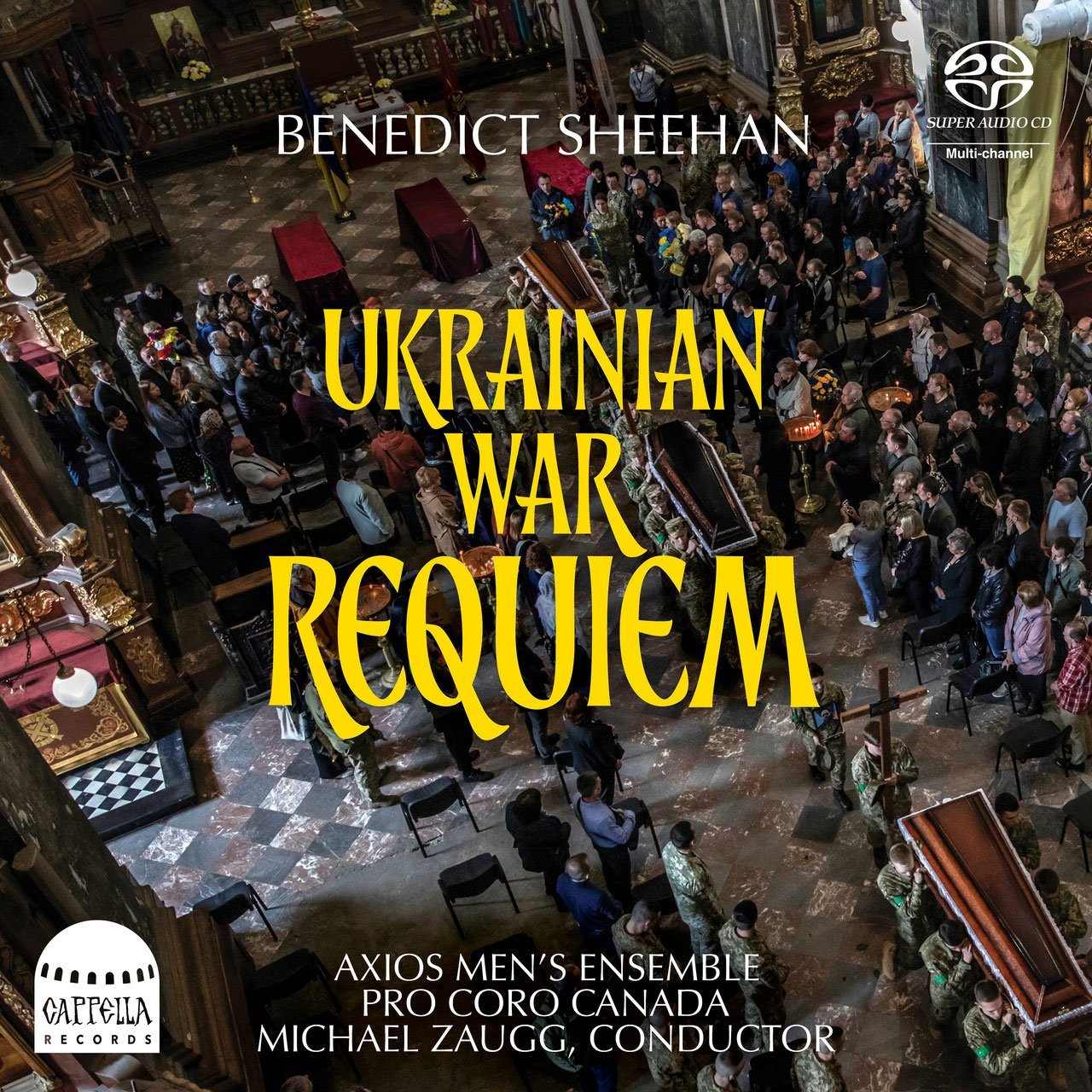
Listen to the Ukrainian War Requiem on Spotify, Apple Music, or anywhere you stream music.
If you’ve never heard Ukrainian liturgical music, you’re not alone. Probably the majority of the world hasn’t heard it, but it’s absolutely stunning. It’s beautiful.
If you’ve ever heard what you might think of as Eastern Church music, Eastern European Orthodox, or Catholic Church music, you’d be in the right area. You’d be in the ballpark.
It’s music that’s sung in church, and generally, when we perform this music, we sing it in churches because it’s a natural fit.
This piece in particular has 12 movements. The majority are quite dark. They’re in minor keys, and there’s a lot of grief, anguish, and feeling in these pieces.
Then the very last piece, called “In Paradisum” — “In Paradise” — is in a major key. That’s actually one of the first times we hear a female voice, our soloist. After you’ve had to struggle through 11 movements of a lot of pain and suffering, her voice really provides the future.
Songs feature Ukrainian, English, and Latin, and that was really purposeful.
Benedict Sheehan did quite a bit of research before he even started composing this music. We thought it was reflective. It’s not that anyone speaks Latin in Ukraine, but it reflects the diversity of the cultures and people in Ukraine, and that’s something Ukrainians celebrate.
There are Catholics, Orthodox Christians, Protestants, and Jewish people. Ukraine really is a diverse country, and we wanted to reflect that diversity in the music.
We also wanted the music to be accessible to the great majority of the world that doesn’t speak Ukrainian, so a lot of it is in English.
Even if people don’t understand the languages being sung, or don’t necessarily come from Ukraine or a religious background, can they still connect with the music?
I think part of the human experience is to feel pain, grief, and sorrow. One of the toughest things to do in life is to soldier on through that alone.
The idea with this music is that we want to perform it for a community that might be mourning Ukraine’s loss and struggle for freedom. But people can also listen to this and connect their own loss and suffering to it.
That’s really the beauty of this music. You don’t have to be Ukrainian to feel something as you listen to the Ukrainian War Requiem.
The piece was recorded in 2024 and released in 2025. Can you bring us into the room on the day of the recording?
For a lot of us, we weren’t just singing music. We were singing something we truly believe in. We were singing for Ukraine, for our families, for our grandparents or maybe our great-grandparents who once immigrated from Ukraine. We were singing about the injustice Ukrainians have had to experience throughout the decades.
That feeling was really palpable as this diverse group of guys got together. We had eight Ukrainians singing on this recording. We had 20 members from Axios and another 20 members from Pro Coro Canada. We all came together around this unifying message of hope and solidarity with Ukraine.
We recorded the Ukrainian War Requiem over three days. The recording was handled by a brilliant producer named Blanton Alspaugh, who’s won 11 Grammys for his work recording choral and symphonic music.
We recorded the album here in Edmonton at St. Basil’s Ukrainian Catholic Cathedral. I was floored when I walked into the church that day. There were over 20 different microphones hanging, standing, and sitting in different places.
We all got into our formation and started to sing. We didn’t record the movements in order. Michael Zaugg, our conductor, took us through what he thought might be some of the more challenging parts to sing, so we worked through those first.
Recording is a very interesting thing because, when you listen to track number five, for example, you hear it from beginning to end. There are no breaks. But when you’re recording, we might sing 25 bars, and Michael and Blanton will have a little chat and think, “Okay, we didn’t love bar 15. Let’s go back and do that section once more.”
It was a lot of putting pieces of a puzzle together until Blanton, Michael, and Benedict, who was there as well, could put their heads together and determine, “Yeah, okay, now we’ve got number five complete,” and move on to number six or seven.
When you’re starting and stopping during a recording, how do you stay connected to the art and emotion of the music while also thinking about the technical process?
It’s just a lot of practice, and it’s something Michael works with all of us on quite a bit.
A lot of singers, maybe even athletes, don’t love the warm-up. It’s kind of boring. It’s bland. It’s vanilla. It feels like something you’ve just got to get through.
But practice is so important because that’s the part where we work on things over and over and over again. Then, finally, when you get into performance or recording, that’s when a lot of the creativity gets to come out.
That’s where Michael works with us to shape the music, maybe stretch out a few bars or really lean into some of the text. We’re only able to do that because we’ve gone through the foundational steps to get there.
That’s some of the brilliance of having a good conductor, a good director at the helm. I think it also speaks to the discipline of our singers. Everybody is there not just because they want to make beautiful music, but because they believe in the message of this music.
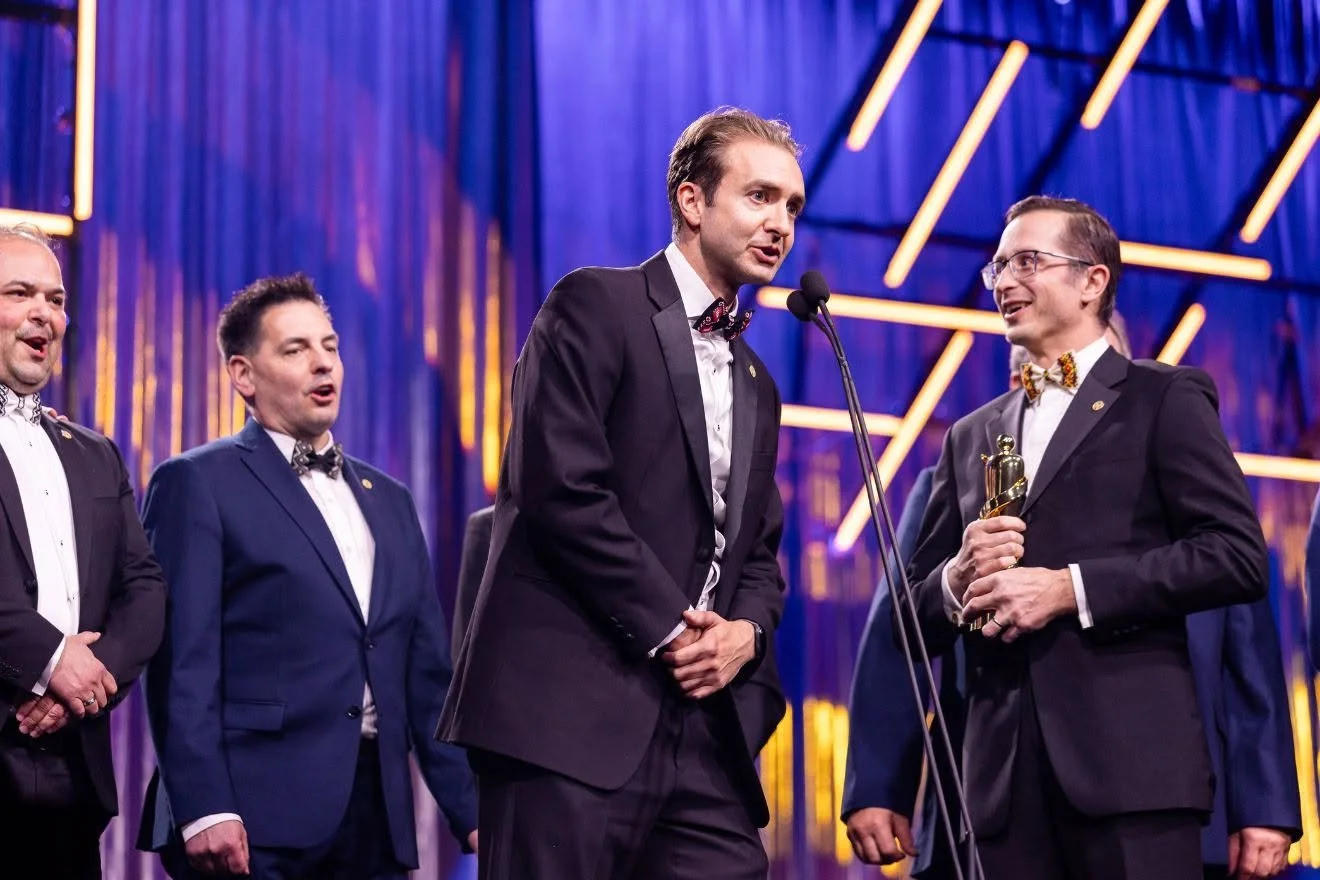
Steven Brese himself on stage at the Junos! Photo from Axios Men’s Ensemble Facebook page.
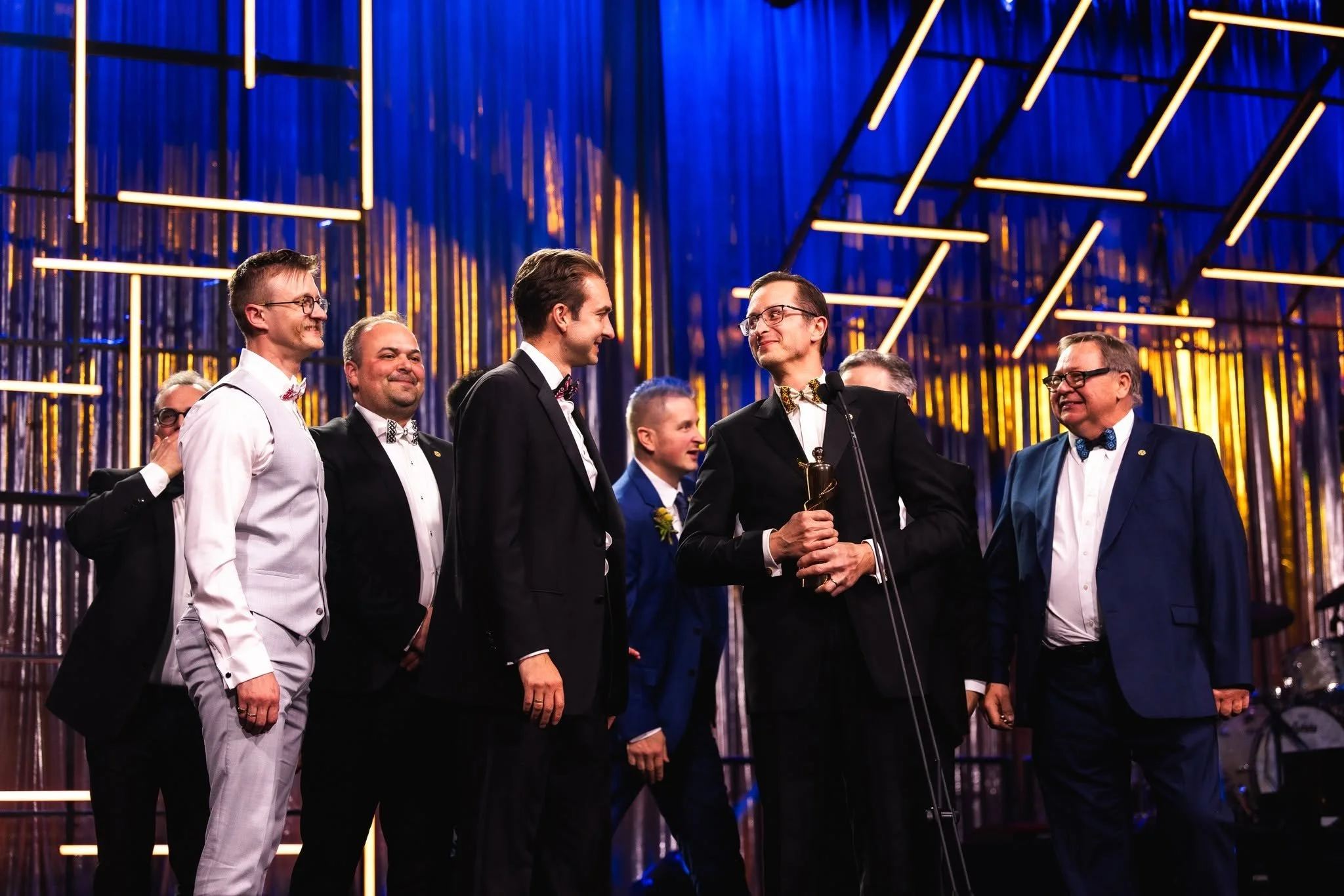
This year, Axios won a Juno Award for Classical Album of the Year (Large Ensemble) for the Ukrainian War Requiem. What did receiving this award mean to everyone involved, especially for a project with such a profound purpose?
It was a huge honour and a privilege to win this award.
It’s not something we set out to do when we got together in Julian’s Piano Bar three or four years earlier. We set out to create beautiful music that could unite a community, bring people together to feel something, to feel grief, to mourn, and to find some hope.
The fact that the Juno Academy recognizes us for this contribution just means the world to us.
It tells us that when you dream big, when you align what you believe in with what you do well, I think this is what happens.
All along the way, from the genesis of the idea to create the Ukrainian War Requiem through to the recording, whenever we had a decision to make, we didn’t want to sacrifice in any way. We wanted to do this at the very highest level, to the very best of our abilities, not simply to create something great, but because we believed in it.
We believed in Ukraine’s fight for freedom. We believed in Ukraine’s right to self-determination, and we wanted to share that belief through one way that we know how — music. We want to share that with the world.
I think that’s why the Junos recognized this music as Classical Album of the Year. It is beautiful in its own right, but it has an enormously powerful message.
You’re bringing the Ukrainian War Requiem to audiences across Canada in November. What does it mean to take this work on the road rather than have it exist only as a recording? What do you hope people will experience when they hear it live?
I think I can speak for a lot of us when I say this is one of the greatest things we’ve ever done.
We’ve all become close friends over the course of the last four years working on this, and it’s now become a part of who we are. This music is something we all feel really deeply and passionately about, and we want to share it with more people.
We want to share it with people who might simply love choral music and have never heard about the Ukrainian War Requiem or Ukrainian liturgical music. This is an opportunity for us to share with the world, with Canadians, and with new communities what Ukraine is going through.
On a personal level, what has being part of this project meant to you?
My grandparents, my Baba and Dido, fled Ukraine during the Second World War. They eventually made their way to a displaced persons camp in Germany, where my mother was born. They lived there for five years before eventually immigrating to Philadelphia and then to Edmonton.
As I get older, I’ve become more interested in my family and the kinds of struggles they’ve gone through.
For me personally, I sing this music partly for them, and partly for the Ukrainians during the Second World War who were faced with an impossible choice: stay in Ukraine and struggle through a Soviet totalitarian state, or leave everything they’d ever known and try to find a better life for themselves and their families.
It’s tragic that 70 years later, history is, in a way, repeating itself. Millions of Ukrainians have been forced to make this impossible choice again, whether to stay in their country or leave.
I sing for my grandparents. I sing for Ukrainians today, and I think a lot of us sing for our family members and our friends.
Do you have a favourite piece from the album?
I do have a favourite. Can I have two?
My first is number seven, “Psalm 50.” I was thinking about why I love it so much, and really, for me, it’s almost like a film. There are so many different parts to it.
There’s this underlying rumble of tension that starts right from the beginning and keeps building and building until we get to this enormous climax. It’s the triple forte, the loudest part of the whole Ukrainian War Requiem. I would challenge anyone not to feel something in that moment.
We’ve been listening to music for the past 45 minutes, and you get to this moment. The few bars that follow feel like an absolute release, like coming down from this precipice, from this high place.
I think that’s some of the magic of Benedict Sheehan and how he’s able to compose and tell a really significant story through notes and words. I really look forward to singing that piece for audiences across Canada.
My other favourite is number nine, called “With the Souls.” I really connect with the words of that piece. It feels almost like a little bit of a break, a bit of breathing room. We’ve been on this incredible journey, and for a moment, we have a reprieve before heading into some heavy stuff to finish off the piece.
It’s absolutely beautiful. I love it from beginning to end, and it’s sort of the last moment before we get into some really heavy material.
Then the very last piece, the final movement of the Ukrainian War Requiem, is “In Paradisum,” where we hear our beautiful, hopeful soprano soloist.
One thing I loved when listening to the album was hearing notes from the Ukrainian national anthem. Was that a creative choice?
Yes. When I first got the music and we read through it and sang it all the way through, it wasn’t something I immediately picked out. It’s almost like what they call Easter eggs — this hidden thread that Benedict has woven all the way through.
I think it makes a real appearance in number 12, the very last movement, where that theme is quite prominent. Throughout the rest of the album, you have to be listening to hear it, but it’s a neat thing.
If people are coming to the performances, listen for the Ukrainian anthem tucked into each of the movements, except for number 11. Benedict had a reason for not using it there, but it’s tucked into all the other pieces. See if you can pick it out.
Has Axios ever done anything like this before? Have you recorded a full album like this or gone on tour, or is this a first?
The Ukrainian War Requiem is our third full album. You can listen to all our albums on Spotify, Apple Music, or anywhere you stream music.
The first album we recorded was The Resurrectional Divine Liturgy of Saint John Chrysostom, which we recorded in 2015. We toured twice with that music. The first tour was across the Prairies, visiting Edmonton, Saskatoon, Regina, and Winnipeg. A year later, we took the music to Toronto, Rochester, New York, and Philadelphia.
A couple of years after recording that album, we recorded Christ Is Born: Hymns and Carols of the Nativity. It’s a really neat cross-section of different Ukrainian Christmas hymns and songs. It’s not folk music, but music you’d hear in a church.
We had quite a break after that, about eight years or so.
One interesting thing about our group is that we only get together when we have a project. We don’t have weekly rehearsals. We either perform music, record music, or do one of our favourite things, which was one of the choir’s original missions — singing liturgies in churches.
Last summer, we picked a number of churches in the Edmonton area that might not have choirs singing the liturgies very often. We approached them and asked, “Could we come and sing a liturgy for your Sunday service?”
We’d roll in with maybe 25 guys and sing the liturgy. It feels like such a gift to sing for a community, a congregation that might not ordinarily get to hear the liturgy sung that way.
The reason it’s a core part of our mission goes back more than 20 years, to a little place in Manitoba called Roblin. There was a Ukrainian Catholic seminary there called Saint Vladimir’s, or Saint Vlad’s.
A fellow named Boris Derow was studying there. He became a monk, and a few other members who currently sing with Axios were also studying there at the time.
After they finished their time in Roblin, they said, “Well, we really enjoyed singing together. Maybe we could figure out how to do this back out in the world.”
Boris assembled a group of guys with similar interests in singing Ukrainian liturgical music. They started singing at church services and continued for years, until around 2015, when they got together and wondered what would happen if they put their heads together and tried to record an album.
That was when they recorded The Resurrectional Divine Liturgy of Saint John Chrysostom. It’s Easter music, music that’s sung at Easter, and we had some pretty big success with it.
By success, I mean we sang for audiences who might not normally get to hear this music, and we received a positive response. So we said, “Yeah, let’s keep doing this.”
Is there any significance to Axios being an all-male choir?
It can be absolutely thunderous, the sound of a four-part men’s choir singing, and it can also be as soft as raindrops on a window. There’s enormous dynamic range and sound that comes from a men’s choir, and Ukrainian liturgical music lends itself well to this.
A lot of the music is composed for a four-part choir. Back in the day, it was often just men singing, so as a men’s choir, we’re spoiled for choice with a lot of wonderful compositions.
Men aren’t known for being super articulate with their emotions or sharing with other men what’s going on in their lives. But one thing we’re able to do as we sing together is be really vulnerable with one another.
Singing is a deeply personal act. To do that with a bunch of guys I care about very deeply, and knowing that everybody cares about each other, is special. One way we’re able to show that is by singing together and making beautiful music.
Thanks so much to Steven for the chat! Listen to the full podcast episode here.
We’re looking forward to seeing the show when it comes to Winnipeg on November 8. Get your tickets to a show in a city near you on the Axios website.